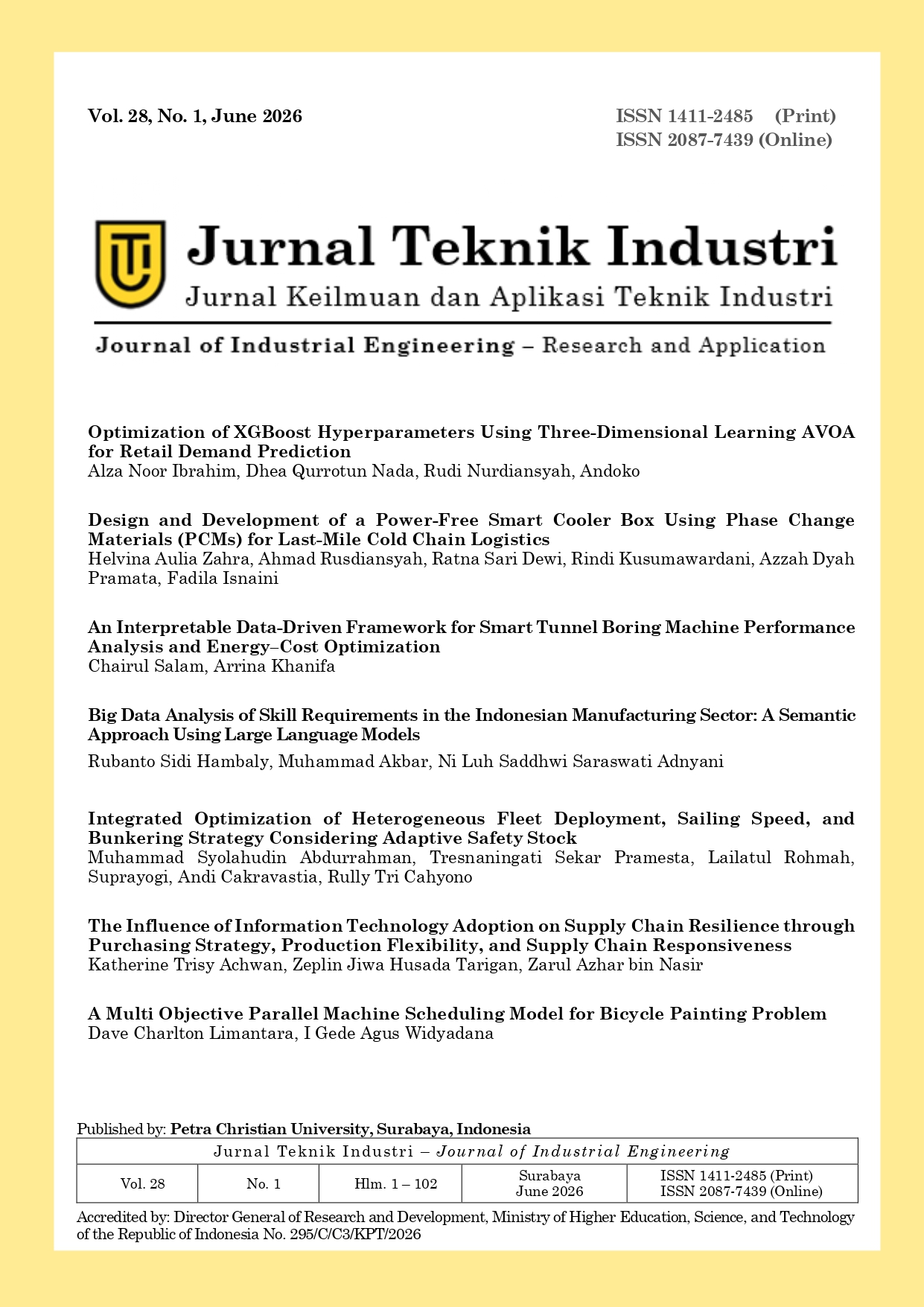
Design and Development of a Power-Free Smart Cooler Box Using Phase Change Materials (PCMs) for Last-Mile Cold Chain Logistics
DOI:
https://doi.org/10.9744/jti.28.1.13-23Keywords:
Last-Mile Delivery, Cold Thermal Energy Storage, Refrigerated Container, TRIZAbstract
The growing demand for fresh products requires efficient and sustainable cold chain logistics, especially in last-mile delivery. Conventional refrigerated trucks utilized in last-mile logistics are hindered by high energy consumption, operational costs, and limited flexibility, creating a critical barrier for small-scale cold chain access. To address these inefficiencies, this research develops a Power-Free Smart Cooler Box that integrates Phase Change Material (PCM) technology with a high-performance composite structure to maintain frozen-grade temperatures without active power. The design methodology employed the Theory of Inventive Problem Solving (TRIZ) to systematically resolve the engineering contradiction between maximizing thermal endurance and minimizing system weight. The resulting configuration features a multi-layer insulation wall (Fiberglass/Vacuum Insulated Panel/Polyurethane) and a validated 6-sided PCM layout. This configuration enables the Smart Cooler Box to maintain an internal air temperature of ≤ −10 °C for more than 10 hours without external power. It is also equipped with a built-in IoT-based temperature sensor to ensure real-time traceability. These findings imply that the developed passive cooler provides a scientifically validated, zero-emission alternative that offers a flexible, energy-efficient, and environmentally friendly option for last-mile logistics while ensuring product safety in the final stage of delivery.
Downloads
References
J. Han, C. Sun, Z. Ji, and X. Yang, “Smart cold chain logistics for fresh agricultural products: Key technologies, challenges, and future trends,” Trends Food Sci. Technol., vol. 167, p. 105421, Jan. 2026, doi: https://doi.org/10.1016/j.tifs.2025.105421.
J.-W. Han, M. Zuo, W.-Y. Zhu, J.-H. Zuo, E.-L. Lü, and X.-T. Yang, “A comprehensive review of cold chain logistics for fresh agricultural products: Current status, challenges, and future trends,” Trends Food Sci. Technol., vol. 109, pp. 536–551, Mar. 2021, doi: https://doi.org/10.1016/j.tifs.2021.01.066.
UN Environment Programme, “Sustainable cold chain and food loss reduction,” Nov. 2019. Accessed: Apr. 04, 2025. [Online]. Available: https://ozone.unep.org/system/files/documents/MOP31-Sustainable-HL_Briefing_Note.pdf
H. Zhao, S. Liu, C. Tian, G. Yan, and D. Wang, “An overview of current status of cold chain in China,” International Journal of Refrigeration, vol. 88, pp. 483–495, Apr. 2018, doi: https://doi.org/10.1016/j.ijrefrig.2018.02.024.
X. Wang et al., “Pathways toward precise monitoring and low-carbon sustainability in fruit cold chain logistics: A solution enabled by flexible temperature sensing,” Materials Today Sustainability, vol. 24, Dec. 2023, doi: https://doi.org/10.1016/j.mtsust.2023.100592.
MarkNtel Advisors, “Indonesia cold chain market research report: Forecast (2025-2030),” 2025. Accessed: Jan. 02, 2026. [Online]. Available: https://www.marknteladvisors.com/research-library/indonesia-cold-chain-market.html
P. D. Sentia, R. Ramadani, and S. Zuhri, “Logistic performance measurement on a port in Aceh,” Jurnal Teknik Industri: Jurnal Keilmuan dan Aplikasi Teknik Industri, vol. 20, no. 1, pp. 59–64, Jun. 2018, doi: https://doi.org/10.9744/jti.20.1.59-64.
International Trade Administration, “Indonesia cold chain industry,” Market Intelligence. Accessed: Sep. 25, 2025. [Online]. Available: https://www.trade.gov/market-intelligence/indonesia-cold-chain-industry
Y. Sahu, “Indonesia cold chain logistics market outlook to 2030,” Dec. 2024. Accessed: Jan. 02, 2026. [Online]. Available: https://www.kenresearch.com/industry-reports/indonesia-cold-chain-logistics-market
P. B. Utomo, Mustaruddin, Mulyono, and R. Muninggar, “Measuring the fish logistics performance index in the indonesian fisheries supply chains (A study case of poumako fishing port of Mimika, Central Papua),” in BIO Web of Conferences, EDP Sciences, Feb. 2024. doi: https://doi.org/10.1051/bioconf/20249201029.
PT Capricorn Indonesia Consult, “A cold chain study of Indonesia,” Jakarta, 2019. Accessed: Dec. 30, 2025. [Online]. Available: https://www.eria.org/uploads/media/8_RPR_FY2018_11_Chapter_4.pdf
H. Kurniawati and X. Zhang, “Intra-regional disparity in Kalimantan: Implications of capital city relocation,” Singapore, Aug. 2023. Accessed: Sep. 25, 2025. [Online]. Available: https://lkyspp.nus.edu.sg/docs/default-source/aci/acirp202314.pdf
Ministry of National Development Planning/Bappenas, “Food loss and waste in Indonesia,” 2021. Accessed: Sep. 25, 2025. [Online]. Available: https://lcdi-indonesia.id/wp-content/uploads/2021/07/Executive-Summary-FLW-ENG.pdf
S. Tong et al., “A phase change material (PCM) based passively cooled container for integrated road-rail cold chain transportation – An experimental study,” Appl. Therm. Eng., vol. 195, Aug. 2021, doi: https://doi.org/10.1016/j.applthermaleng.2021.117204.
R. R. Yenare et al., “A comprehensive review of portable cold storage: Technologies, applications, and future trends,” Alexandria Engineering Journal, vol. 94, pp.23-33, May 2024, doi: https://doi.org/10.1016/j.aej.2024.03.014.
R. S. Dewi, A. Rusdiansyah, and F. Herdiansyah, “Perancangan kontainer berpendingin pada sepeda motor dengan metoda QFD dan TRIZ,” INVOTEK: Jurnal Inovasi Vokasional dan Teknologi, vol. 20, no. 1, pp. 13–26, Feb. 2020, doi: https://doi.org/10.24036/invotek.v20i1.752.
I. Santosa, I. Waisnawa, A. Sapteka, and I. Budiarta, “Design analysis of transportation refrigeration container with photovoltaic and compatible to electric vehicle,” in Proceedings of the 5th International Conference on Applied Science and Technology on Engineering Science, SCITEPRESS - Science and Technology Publications, 2022, pp. 541–546. doi: https://doi.org/10.5220/0011819800003575.
T. B. Umate and P. D. Sawarkar, “A review on thermal energy storage using phase change materials for refrigerated trucks: Active and passive approaches,” J. Energy Storage, vol. 75, p. 109704, Jan. 2024, doi: https://doi.org/10.1016/j.est.2023.109704.
Y. Sha, W. Hua, H. Cao, and X. Zhang, “Properties and encapsulation forms of phase change material and various types of cold storage box for cold chain logistics: A review,” J. Energy Storage, vol. 55, p. 105426, Nov. 2022, doi: https://doi.org/10.1016/j.est.2022.105426.
S. Burgess, X. Wang, A. Rahbari, and M. Hangi, “Optimisation of a portable phase-change material (PCM) storage system for emerging cold-chain delivery applications,” J. Energy Storage, vol. 52, Aug. 2022, doi: https://doi.org/10.1016/j.est.2022.104855.
N. Kapilan, K. A. Kumar, and K. Gowda, “Recent advances in applications of phase change materials in cold storage - A review,” in Materials Today: Proceedings, Elsevier Ltd, 2021, pp. 2410–2414. doi: https://doi.org/10.1016/j.matpr.2021.04.442.
X. Xu, X. Zhang, and J. M. Munyalo, “Key technologies and research progress on enhanced characteristics of cold thermal energy storage,” Journal of Molecular Liquids, vol. 278, pp. 428-237, Mar. 15, 2019, doi: https://doi.org/10.1016/j.molliq.2019.01.040.
B. Huang, S. Yang, J. Wang, and P. D. Lund, “Optimizing the shape of PCM container to enhance the melting process,” Oxford Open Energy, vol. 1, Jan. 2022, doi: https://doi.org/10.1093/ooenergy/oiab006.
R. Badia-Melis, U. Mc Carthy, L. Ruiz-Garcia, J. Garcia-Hierro, and J. I. Robla Villalba, “New trends in cold chain monitoring applications - A review,” Food Control, vol. 86, pp. 170-182, Apr. 01, 2018, doi: https://doi.org/10.1016/j.foodcont.2017.11.022.
A. Chaudhuri, I. Dukovska-Popovska, N. Subramanian, H. K. Chan, and R. Bai, “Decision-making in cold chain logistics using data analytics: A literature review,” The International Journal of Logistics Management, vol. 29, no. 3, pp. 839–861, Aug. 2018, doi: https://doi.org/10.1108/IJLM-03-2017-0059.
S. S. Kamble, A. Gunasekaran, H. Parekh, and S. Joshi, “Modeling the internet of things adoption barriers in food retail supply chains,” Journal of Retailing and Consumer Services, vol. 48, pp. 154–168, May 2019, doi: https://doi.org/10.1016/j.jretconser.2019.02.020.
A. Y. Cil, D. Abdurahman, and I. Cil, “Internet of Things enabled real time cold chain monitoring in a container port,” Journal of Shipping and Trade, vol. 7, no. 1, Dec. 2022, doi: https://doi.org/10.1186/s41072-022-00110-z.
S. Kandukuri, E. E. Günay, O. Al-Araidah, and G. E. Okudan Kremer, “Inventive solutions for remanufacturing using additive manufacturing: ETRIZ,” J. Clean. Prod., vol. 305, Jul. 2021, doi: https://doi.org/10.1016/j.jclepro.2021.126992.
D. Russo and C. Spreafico, “TRIZ-Based Guidelines for Eco-Improvement,” Sustainability, vol. 12, no. 8, 2020, doi: https://doi.org/10.3390/su12083412
V. Petrov, TRIZ. Theory of Inventive Problem Solving: Level 1. Springer International Publishing, 2019. doi: https://doi.org/10.1007/978-3-030-04254-7.
J. Du, B. Nie, Y. Zhang, Z. Du, li Wang, and Y. Ding, “Cooling performance of a thermal energy storage-based portable box for cold chain applications,” J. Energy Storage, vol. 28, Apr. 2020, doi: https://doi.org/10.1016/j.est.2020.101238.
X. Xiaofeng and Z. Xuelai, “Simulation and experimental investigation of a multi-temperature insulation box with phase change materials for cold storage,” J. Food Eng., vol. 292, Mar. 2021, doi: https://doi.org/10.1016/j.jfoodeng.2020.110286.
S. Verma and H. Singh, “Vacuum insulation in cold chain equipment: A review,” Energy Procedia, vol. 161, pp. 232–241, Mar. 2019, doi: https://doi.org/10.1016/j.egypro.2019.02.086.
A. K. Ray, S. Singh, D. Rakshit, and Udayraj, “Comparative study of cooling performance for portable cold storage box using phase change medium,” Thermal Science and Engineering Progress, vol. 27, Jan. 2022, doi: https://doi.org/10.1016/j.tsep.2021.101146.
N. Ndraha, H. I. Hsiao, J. Vlajic, M. F. Yang, and H. T. V. Lin, “Time-temperature abuse in the food cold chain: Review of issues, challenges, and recommendations,” Jul. 01, 2018, Elsevier Ltd. doi: https://doi.org/10.1016/j.foodcont.2018.01.027.
Q. Gan, Y. Zhang, Z. Zhang, M. Chen, J. Zhao, and X. Wang, “Influencing factors of cooling performance of portable cold storage box for vaccine supply chain: An experimental study,” J. Energy Storage, vol. 72, Nov. 2023, doi: https://doi.org/10.1016/j.est.2023.108212.
J.-P. Rodrigue, The Geography of Transport Systems. London: Routledge, 2024. doi: https://doi.org/10.4324/9781003343196.
M. Calati, K. Hooman, and S. Mancin, “Thermal storage based on phase change materials (PCMs) for refrigerated transport and distribution applications along the cold chain: A review,” International Journal of Thermofluids, vol. 16, Nov. 2022, doi: https://doi.org/10.1016/j.ijft.2022.100224.
R. R. Yenare et al., “Numerical analysis of phase change material placement and temperature effects in cold storage systems,” Alexandria Engineering Journal, vol. 129, pp. 1024–1038, Oct. 2025, doi: https://doi.org/10.1016/j.aej.2025.07.019.
L. Huang and U. Piontek, “Improving performance of cold-chain insulated container with phase change material: An experimental investigation,” Applied Sciences (Switzerland), vol. 7, no. 12, Dec. 2017, doi: https://doi.org/10.3390/app7121288.
M. Khairulmaini, Z. Michael, M. A. M. Shah, M. S. Zakaria, B. Abdullah, and A. A. Rashid, “Improvement of insulation material for cool box application,” IOP Conf. Ser. Mater. Sci. Eng., vol. 834, no. 1, p. 012019, Apr. 2020, doi: https://doi.org/10.1088/1757-899X/834/1/012019.
Downloads
Published
Issue
Section
License
Copyright (c) 2026 Helvina Aulia Zahra, Ahmad Rusdiansyah, Ratna Sari Dewi, Rindi Kusumawardani, Azzah Dyah Pramata, Fadila Isnaini

This work is licensed under a Creative Commons Attribution 4.0 International License.
Articles published in the Jurnal Teknik Industri: Jurnal Keilmuan dan Aplikasi Teknik Industri will be Open-Access articles distributed under the terms and conditions of the Creative Commons Attribution License (CC BY).

This work is licensed under a Creative Commons Attribution License (CC BY).