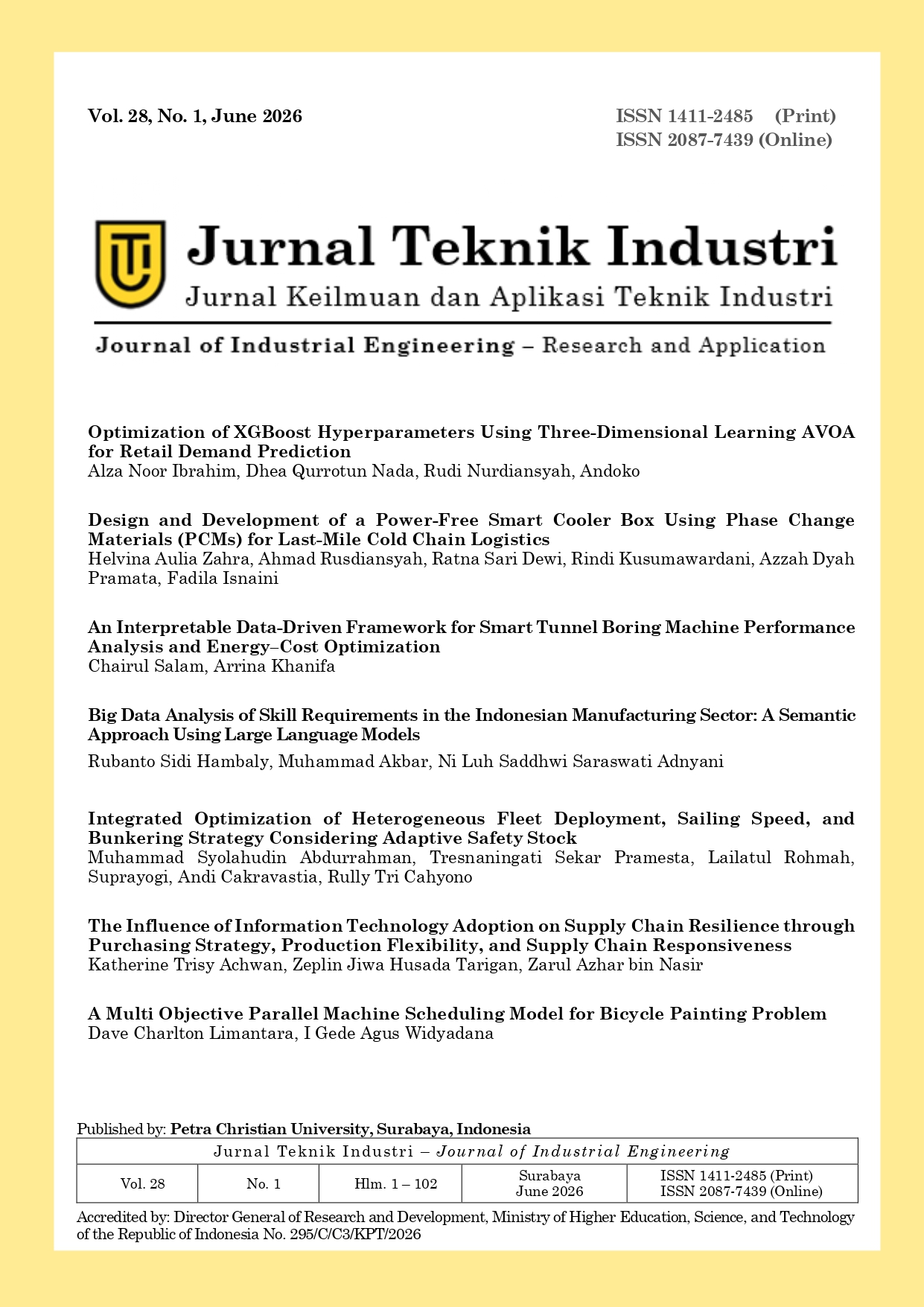
Integrated Optimization of Heterogeneous Fleet Deployment, Sailing Speed, and Bunkering Strategy Considering Adaptive Safety Stock
DOI:
https://doi.org/10.9744/jti.28.1.59-75Keywords:
Fleet deployment, bunkering strategies, liner shipping, fuel consumption, speed optimization, mixed-integer linear programmingAbstract
Logistics cost inefficiencies often stem from fragmented operational policies. Volatile global fuel prices and unpredictable maritime schedules further complicate matters. Traditional isolated optimization methods frequently fail to ensure supply chain resilience. This study addresses these limitations by developing a Mixed-Integer Linear Programming (MILP) model. The model simultaneously integrates three core strategic decisions: heterogeneous fleet deployment, sailing speed optimization, and bunkering strategy. Inventory thresholds are dynamically adjusted based on real-time sailing conditions and port-to-port consumption rates, moving beyond static buffer assumptions. This model incorporates an adaptive stock mechanism to mitigate energy supply uncertainties at transit ports while minimizing total costs, which diverges from conventional approaches. The mathematical formulation is designed to minimize total operating expenses while accounting for technical constraints, such as fixed time windows and fluctuating cargo capacities. Optimization results show that integrating these variables effectively reduces cost inefficiencies. Quantitatively, the Proposed Scenario reduced Total Cost by 18.89%, saving USD 191,555 per service cycle compared to the Existing Scenario. The integrated approach uncovers a significant trade-off between speed reduction and inventory holding costs, identifying a more balanced operational equilibrium than previous models. The findings demonstrate that applying adaptive safety stock enhances the robustness of the bunkering strategy by aligning minimum inventory levels with fuel consumption across segments between bunkering ports. This study contributes to maritime management theory by synchronizing adaptive fuel inventory management with vessel deployment and speed optimization. There are practical implications for designing more resilient and cost-effective shipping strategies. Finally, this framework serves as a precursor tool for shipping liners to maintain service reliability while navigating the complexities of modern maritime logistics.
Downloads
References
Y. Xing, X. Lv, H. Yang, J. Zheng, and B. Liu, “Optimization of containership sailing speed and fleet deployment under two carbon tax schemes,” Ocean Engineering, vol. 341, Dec. 2025, doi: https://doi.org/10.1016/j.oceaneng.2025.122716.
F. Julio, A. Vanni, S. Amanda, V. Joey, and S. Halim, “Optimizing shipping operations through real-time monitoring and control,” Jurnal Teknik Industri: Jurnal Keilmuan dan Aplikasi Teknik Industri, vol. 25, no. 1, pp. 43–52, May 2023, doi: https://doi.org/10.9744/jti.25.1.43-52.
M. F. Pradana, B. Bahn, and B. Noche, “Optimization of fleet size and mix problems in Indonesian sea tollway,” Logistics Journal, vol. 2021, no. 10, 2021, doi: https://doi.org/10.2195/lj_NotRev_pradana_en_202110_01.
Kementrian Perdagangan, “Trayek tol laut 2026,” https://geraimaritim.kemendag.go.id/trayek.
Q. Wang, J. Zhou, Z. Li, and S. Liu, “Towards sustainable shipping: joint optimization of ship speed and bunkering strategy considering ship emissions,” Atmosphere (Basel), vol. 16, no. 3, Mar. 2025, doi: https://doi.org/10.3390/atmos16030285.
R. Y. H. Silitonga, L. R. Kristiana, and T. A. Parley, “A multi-item probabilistic inventory model that considers expiration factor, all unit discount policy and warehouse capacity constraints,” Jurnal Teknik Industri: Jurnal Keilmuan dan Aplikasi Teknik Industri, vol. 23, no. 2, pp. 139–148, Oct. 2021, doi: https://doi.org/10.9744/jti.23.2.139-148.
M. Lashgari, A. A. Akbari, and S. Nasersarraf, “A new model for simultaneously optimizing ship route, sailing speed, and fuel consumption in a shipping problem under different price scenarios,” Applied Ocean Research, vol. 113, Aug. 2021, doi: https://doi.org/10.1016/j.apor.2021.102725.
M. Christiansen, E. Hellsten, D. Pisinger, D. Sacramento, and C. Vilhelmsen, “Liner shipping network design,” Oct. 01, 2020, Elsevier B.V. doi: https://doi.org/10.1016/j.ejor.2019.09.057.
D. Wetzel and K. Tierney, “Rethinking cyclic structures in liner shipping networks,” Eur. J. Oper. Res., vol. 316, no. 2, pp. 556–568, Jul. 2024, doi: https://doi.org/10.1016/j.ejor.2024.01.035.
L. Zhen, Y. Hu, S. Wang, G. Laporte, and Y. Wu, “Fleet deployment and demand fulfillment for container shipping liners,” Transportation Research Part B: Methodological, vol. 120, pp. 15–32, Feb. 2019, doi: https://doi.org/10.1016/j.trb.2018.11.011.
D. Zhuge, S. Wang, and D. Z. W. Wang, “A joint liner ship path, speed and deployment problem under emission reduction measures,” Transportation Research Part B: Methodological, vol. 144, pp. 155–173, Feb. 2021, doi: https://doi.org/10.1016/j.trb.2020.12.006.
M. F. Pradana, B. Bahn, and B. Noche, “Optimization of fleet size and mix problems in Indonesian sea tollway,” Logistics Journal, vol. 2021, no. 10, 2021, doi: https://doi.org/10.2195/lj_NotRev_pradana_en_202110_01.
Z. Wei, X. Xie, and T. Bao, “Liner sailing speed optimization considering wind and waves,” Journal of Marine Science and Technology (Taiwan), vol. 29, no. 3, pp. 417–432, 2021, doi: https://doi.org/10.51400/2709-6998.1469.
J. Pasha et al., “An integrated optimization method for tactical-level planning in liner shipping with heterogeneous ship fleet and environmental considerations,” Advanced Engineering Informatics, vol. 48, Apr. 2021, doi: https://doi.org/10.1016/j.aei.2021.101299.
J. Du and P. Wu, “Stochastic dynamic programming model for liner international scheduling optimization under ECA policies,” Mar. Pollut. Bull., vol. 222, Jan. 2026, doi: https://doi.org/10.1016/j.marpolbul.2025.118766.
A. De, A. Choudhary, M. Turkay, and M. K. Tiwari, “Bunkering policies for a fuel bunker management problem for liner shipping networks,” Eur. J. Oper. Res., vol. 289, no. 3, pp. 927–939, Mar. 2021, doi: https://doi.org/10.1016/j.ejor.2019.07.044.
A. Akbar, A. K. A. Aasen, M. K. Msakni, K. Fagerholt, E. Lindstad, and F. Meisel, “An economic analysis of introducing autonomous ships in a short-sea liner shipping network,” International Transactions in Operational Research, vol. 28, no. 4, pp. 1740–1764, Jul. 2021, doi: https://doi.org/10.1111/itor.12788.
Y. Zhao, Z. Peng, J. Zhou, T. Notteboom, and Y. Ma, “Toward green container liner shipping: Joint optimization of heterogeneous fleet deployment, speed optimization, and fuel bunkering,” International Transactions in Operational Research, vol. 32, no. 6, pp. 3347–3384, Nov. 2025, doi: https://doi.org/10.1111/itor.13552.
C. C. Lu, H. C. Li, and H. Y. Chen, “An optimization model for supporting bunkering decisions in bulk shipping,” Journal of Marine Science and Technology (Taiwan), vol. 33, no. 2, pp. 180–193, 2025, doi: https://doi.org/10.51400/2709-6998.2774.
P. He, J. G. Jin, W. Pan, and J. Chen, “Route, speed, and bunkering optimization for LNG-fueled tramp ship with alternative bunkering ports,” Ocean Engineering, vol. 305, Aug. 2024, doi: https://doi.org/10.1016/j.oceaneng.2024.117957.
C. Wang, X. Liu, Y. Zhou, and J. Qian, “Optimization of speed and refueling strategy for liner shipping companies considering refueling at OPL,” Reg. Stud. Mar. Sci., vol. 89, Dec. 2025, doi: https://doi.org/10.1016/j.rsma.2025.104355.
M. Lashgari, A. A. Akbari, and S. Nasersarraf, “A new model for simultaneously optimizing ship route, sailing speed, and fuel consumption in a shipping problem under different price scenarios,” Applied Ocean Research, vol. 113, Aug. 2021, doi: https://doi.org/10.1016/j.apor.2021.102725.
D. Zhuge, S. Wang, and D. Z. W. Wang, “A joint liner ship path, speed and deployment problem under emission reduction measures,” Transportation Research Part B: Methodological, vol. 144, pp. 155–173, Feb. 2021, doi: https://doi.org/10.1016/j.trb.2020.12.006.
Y. Wu, Y. Huang, H. Wang, and L. Zhen, “Joint planning of fleet deployment, ship refueling, and speed optimization for dual-fuel ships considering methane slip,” J. Mar. Sci. Eng., vol. 10, no. 11, Nov. 2022, doi: https://doi.org/10.3390/jmse10111690.
D. Y. Lin and P. W. Leong, “A stochastic sailing speed optimization and vessel deployment problem in liner shipping,” Journal of Marine Science and Technology (Taiwan), vol. 30, no. 3, pp. 249–259, 2022, doi: https://doi.org/10.51400/2709-6998.2580.
P. He, J. G. Jin, W. Pan, and J. Chen, “Route, speed, and bunkering optimization for LNG-fueled tramp ship with alternative bunkering ports,” Ocean Engineering, vol. 305, Aug. 2024, doi: https://doi.org/10.1016/j.oceaneng.2024.117957.
C. Wang, X. Liu, Y. Zhou, and J. Qian, “Optimization of speed and refueling strategy for liner shipping companies considering refueling at OPL,” Reg. Stud. Mar. Sci., vol. 89, Dec. 2025, doi: https://doi.org/10.1016/j.rsma.2025.104355.
Y. Xing, X. Lv, H. Yang, J. Zheng, and B. Liu, “Optimization of containership sailing speed and fleet deployment under two carbon tax schemes,” Ocean Engineering, vol. 341, Dec. 2025, doi: https://doi.org/10.1016/j.oceaneng.2025.122716.
Y. Zhao, Z. Peng, J. Zhou, T. Notteboom, and Y. Ma, “Toward green container liner shipping: Joint optimization of heterogeneous fleet deployment, speed optimization, and fuel bunkering,” International Transactions in Operational Research, vol. 32, no. 6, pp. 3347–3384, Nov. 2025, doi: https://doi.org/10.1111/itor.13552.
M. Alnahhal, B. L. Aylak, M. Al Hazza, and A. Sakhrieh, “Economic order quantity: A state-of-the-art in the era of uncertain supply chains,” Jul. 01, 2024, Multidisciplinary Digital Publishing Institute (MDPI). doi: https://doi.org/10.3390/su16145965.
A. Zhang, Z. Zheng, and C. P. Teo, “Schedule reliability in liner shipping timetable design: A convex programming approach,” Transportation Research Part B: Methodological, vol. 155, pp. 499–525, Jan. 2022, doi: https://doi.org/10.1016/j.trb.2021.11.010.
N. F. Septiana and I. Sukarno, “Safety stock analysis of ship fuel in shipping company (Case study: White oil ship PT. Pertamina (Persero)),” in IOP Conference Series: Materials Science and Engineering, Institute of Physics Publishing, May 2020. doi: https://doi.org/10.1088/1757-899X/847/1/012021.
Downloads
Published
Issue
Section
License
Copyright (c) 2026 Muhammad Syolahudin Abdurrahman, Tresnaningati Sekar Pramesta, Lailatul Rohmah, Suprayogi, Andi Cakravastia, Rully Tri Cahyono

This work is licensed under a Creative Commons Attribution 4.0 International License.
Articles published in the Jurnal Teknik Industri: Jurnal Keilmuan dan Aplikasi Teknik Industri will be Open-Access articles distributed under the terms and conditions of the Creative Commons Attribution License (CC BY).

This work is licensed under a Creative Commons Attribution License (CC BY).