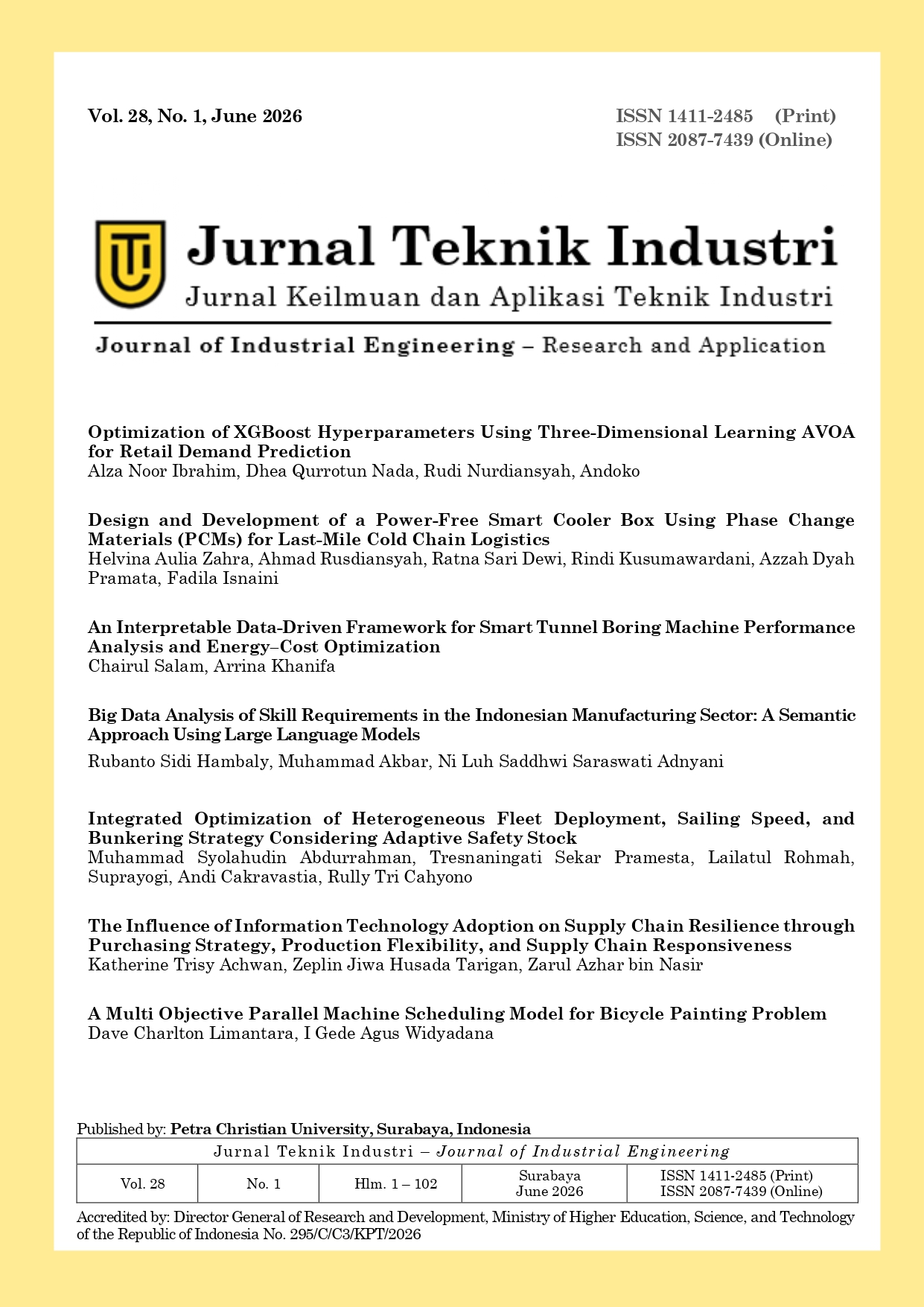
Big Data Analysis of Skill Requirements in the Indonesian Manufacturing Sector
A Semantic Approach Using Large Language Models
DOI:
https://doi.org/10.9744/jti.28.1.47-58Keywords:
Data-Driven Decision-Making, Skill Mismatch, Large Language Models, ESCO taxonomy, manufacturing industryAbstract
The rapid acceleration of Industry 4.0 has fundamentally reshaped industrial competency demands, resulting in the "skill mismatch" phenomenon and contributing to structural unemployment in Indonesia. Effective labor market analysis is required, but traditional analyses often rely on rigid, retrospective survey methodologies that fail to capture these fast-paced dynamics in real time. This study addresses this gap by introducing a novel data-driven pipeline that validates 2,688 web-scraped job advertisements against official national manufacturing registries: Statistics Indonesia (BPS) and the Mandatory Labor Report (WLKP). This registry-based validation ensures data integrity by filtering out 51.7% of unverified postings, guaranteeing that the analysis is derived exclusively from legitimate firms within the verified manufacturing sector. A semantic approach using the Gemini-based Large Language Model (LLM) was implemented to extract, normalize unstructured data into the ESCO taxonomy, and categorize it. Unlike traditional NLP metrics that often fail to maintain functional relevance, the LLM-based approach successfully preserves professional context. While automated exact matching with the rigid ESCO framework yielded low accuracy (24.3% for titles; 9.8% for skills), expert validation confirmed high semantic accuracy of 81.5% and 85%, respectively. Strategic insights reveal a dual-track workforce structure: vocational graduates require technical dexterity for operational roles, while higher education graduates are sought for strategic oversight. Analysis reveals a dominant focus on operational excellence, with specialized digital demand varying by sector, such as CATIA for high-precision engineering in the automotive sector and Optitex for 3D-digital workflows in the apparel industry. This framework serves as an industrial demand blueprint for curriculum-industry alignment, while offering a synthesized scientific interpretation of the underlying labor market patterns.
Downloads
References
G. Li, C. Yuan, S. Kamarthi, M. Moghaddam, and X. Jin, “Data science skills and domain knowledge requirements in the manufacturing industry : A gap analysis,” J. Manuf. Syst., vol. 60, no. July, pp. 692–706, 2021, doi: https://doi.org/10.1016/j.jmsy.2021.07.007.
S. R. Mubaroq, I. Gustiana, F. Alamsari, M. Artarina, and H. Nurohmah, “Proactive socio-technical system as an unemployment solution in West Java,” J. Phys. Conf. Ser., vol. 1402, no. 2, 2019, doi: https://doi.org/10.1088/1742-6596/1402/2/022072.
T. Akyazi, P. del Val, A. Goti, and A. Oyarbide, “Identifying Future skill requirements of the job profiles for a sustainable European manufacturing Industry 4.0,” MDPI Recycl. J., 2022, doi: https://doi.org/10.3390/recycling7030032.
K. C. Nguyen and A. Bosselut, “Rethinking skill extraction in the job market domain using large language models,” Assoc. Comput. Linguist, no. Nlp4hr, pp. 27–42, 2024, doi: https://doi.org/10.18653/v1/2024.nlp4hr-1.3.
P. Hoang, T. Mahoney, F. Javed, and M. McNair, “Large-scale occupational online recruitment,” AI Mag., pp. 5–14, 2018, doi: https://doi.org/10.1609%2Faimag.v39i1.2775.
A. Kumar, K. Chauhan, and J. K. Grewal, “Web scraping job portals,” Adv. Commun. Syst., pp. 291–303, 2024, doi: https://doi.org/10.56155/978-81-955020-7-3-25.
I. Khaouja, “A survey on skill identification from online job ads,” IEEE Access, vol. 9, pp. 118134–118153, 2021, doi: https://doi.org/10.1109/ACCESS.2021.3106120.
F. Clemens, H. H. Özdemir, and G. Schuh, “Identification of text mining use cases in manufacturing companies,” in Conference On Production Systems And Logistics, 2023. doi: https://doi.org/10.15488/15241.
L. Malandri and F. Mercorio, “SkiLLMo: Normalized ESCO skill extraction through transformer models,” Assoc. Comput. Mach., no. March, 2025, doi: https://doi.org/10.1145/3672608.3707960.
L. J. Gonzalez-Gomez et al., “Dynamic taxonomy generation for future skills identification using a named entity recognition and relation extraction pipeline,” Front. Artif. Intell., vol. 8, 2025, doi: https://doi.org/10.3389/ 2025.1579998.
D. Christos, K. Georgiou, E. Papaioannou, K. Petrakis, N. Mittas, and L. Angelis, “ESCOX : A tool for skill and occupation extraction using LLMs from unstructured text,” Softw. Impacts, vol. 25, no. June, p. 100772, 2025, doi: https://doi.org/10.1016/j.simpa.2025.100772.
K. Z. Akhilla, A. Sukmawati, and B. Sartono, “Identifying the types of future skills needed in the manufacturing industry: A systematic literature review,” J. Apl. Bisnis Dan Manaj., vol. 11, 2025, doi: https://doi.org/10.17358/jabm.11.3.1099.
K. Djunaidi, D. T. Kusuma, R. F. Ningrum, P. C. Siswipraptini, and D. F. Murad, “Big data analytics of knowledge and skill sets for web development using latent Dirichlet allocation and clustering analysis,” Adv. Comput. Sci. Appl., no. January, 2025, doi: https://doi.org/10.14569/IJACSA.2025.0160123.
A. G. Budianto, A. T. E. Suryo, A. F. Zulkarnain, G. R. Cahyono, R. Rusilawati, and S. F. Az-Zahra, “A text mining approach to analyzing the omnichannel retail business performance of the KlikIndomaret app,” J. Tek. Ind. J. Keilmuan dan Apl. Tek. Ind., vol. 26, no. 2, pp. 131–144, 2024, doi: https://doi.org/10.9744/jti. 26.2.131-144.
J. Brasse, M. Förster, P. Hühn, J. Klier, M. Klier, and L. Moestue, Preparing for the future of work : A novel data ‑ driven approach for the identification of future skills, Journal of Business Economics, vol. 94, no. 3, pp. 467-500, 2024. doi: https://doi.org/10.1007/s11573-023-01169-1.
P. C. Siswipraptini, H. Leslie, H. Spits, A. Ramadhan, and W. Budiharto, “Information technology job profile using average-linkage hierarchical clustering analysis,” IEEE Access, vol. 11, no. August, pp. 94647–94663, 2023, doi: https://doi.org/10.1109/ACCESS.2023.3311203.
G. Melo, M. Chaves, M. K. B, and J. H. Schleifenbaum, “Skills requirements of additive manufacturing - a textual analysis of job postings using natural language processing,” Proceeding of AMPA: International Conference on Additive Manufacturing in Products and Applications, pp. 299–316, 2023, doi: https://doi.org/10.1007/978-3-031-42983-5.
F. De Felice, C. Salzano, I. Baffo, A. Forcina, and A. Petrillo, “Towards a sustainable digital manufacturing: A state of art,” Procedia Comput. Sci., vol. 232, pp. 1918–1929, 2024, doi: https://doi.org/10.1016/j.procs.2024.02.014.
F. Acerbi, M. Rossi, and S. Terzi, “Identifying and assessing the required i4.0 skills for manufacturing companies ’ workforce,” Front. Manuf. Technol., vol. 2, no. July, pp. 1–19, 2022, doi: https://doi.org/10.3389/fmtec. 2022.921445.
S. Saniuk, “Knowledge and skills of industrial employees and managerial staff for the Industry 4.0 implementation,” Mob. Networks Appl., vol. 28, pp. 220–230, 2023, doi: https://doi.org/10.1007/s11036-021-01788-4.
A. Islam, “Industry 4.0 : Skill set for employability,” Soc. Sci. Humanit. Open, vol. 6, no. 1, p. 100280, 2022, doi: https://doi.org/10.1016/j.ssaho.2022.100280.
Y. O. Abdallah, E. Shehab, and A. Al-ashaab, “Understanding digital transformation in the manufacturing industry : A systematic literature review and future trends,” Prod. Manag. Dev., vol. 19, no. 1, pp. 1–12, 2021, doi: https://doi.org/10.4322/pmd.2021.001.
B. Gajdzik and R. Wolniak, “Smart production workers in terms of creativity and innovation : The implication for open innovation,” J. Open Innov. Technol. Mark. Complex, vol. 8, no. 2, p. 68, 2022, doi: https://doi.org/10.3390/joitmc8020068.
E. Beke, R. Horvath, and K. Takacs-Gyorgy, “Industry 4.0 and current competencies,” Sciendo, vol. 66, no. 4, pp. 63–70, 2020, doi: https://doi.org/10.2478/ngoe-2020-0024.
R. Gázquez et al., “Lack of skills, knowledge, and competences in higher education about Industry 4.0 in the manufacturing sector,” Rev. Iberoam. Educ. a Distancia, vol. 24, 2021, doi: https://doi.org/10.5944/ried.24.1.27548.
Downloads
Published
Issue
Section
License
Copyright (c) 2026 Rubanto Sidi Hambaly, Muhammad Akbar, Ni Luh Saddhwi Saraswati Adnyani

This work is licensed under a Creative Commons Attribution 4.0 International License.
Articles published in the Jurnal Teknik Industri: Jurnal Keilmuan dan Aplikasi Teknik Industri will be Open-Access articles distributed under the terms and conditions of the Creative Commons Attribution License (CC BY).

This work is licensed under a Creative Commons Attribution License (CC BY).