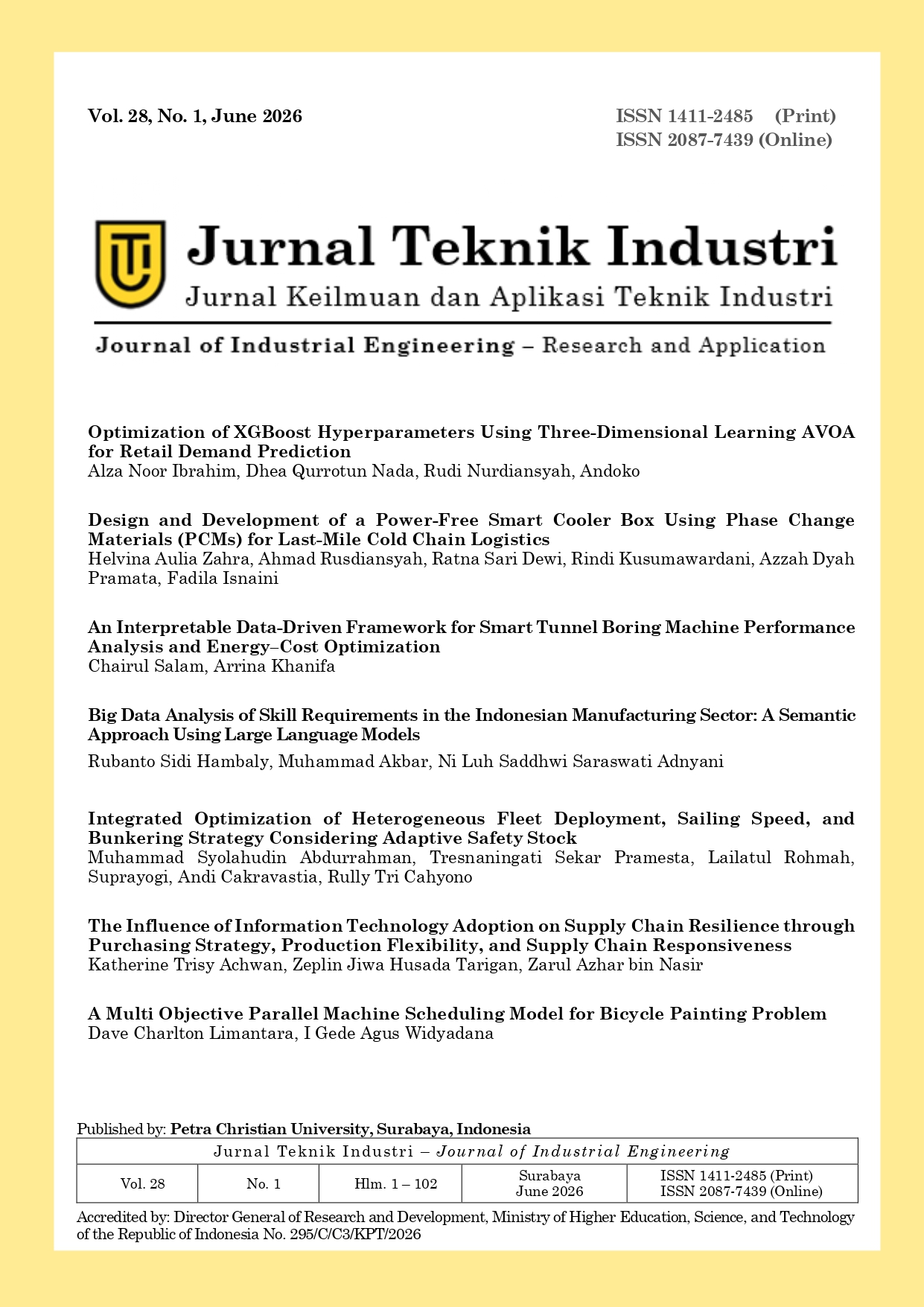
Optimization of XGBoost Hyperparameters Using Three-Dimensional Learning AVOA for Retail Demand Prediction
DOI:
https://doi.org/10.9744/jti.28.1.1-12Keywords:
XGBoost, TDLAVOA, optimization, forecasting, retailAbstract
Accurate demand forecasting is critical for retail supply chains, particularly in the Fast-Moving Consumer Goods (FMCG) sector, where even small discrepancies between predicted and actual demand can lead to excess inventory or stock shortages. This study proposes a hybrid TDLAVOA–XGBoost model that adaptively optimizes key hyperparameters to improve forecasting accuracy and stability. The analysis is conducted using 990 FMCG inventory records from a publicly available dataset to examine the impact of metaheuristic-based optimization on model performance. The TDLAVOA algorithm identifies an effective hyperparameter configuration (max_depth = 3, learning_rate = 0.01, n_estimators = 100, gamma = 1.97, subsample = 0.57, and colsample_bytree = 0.66), enabling the proposed model to achieve an RMSE of 22.53 ± 0.50 and an MAE of 19.32 ± 0.33. Compared with the default XGBoost baseline, this represents a substantial reduction in prediction error and variability. Comparative results show that TDLAVOA–XGBoost achieves performance comparable to SARIMAX and demonstrates superior accuracy relative to deep learning models, including LSTM and MLP, for limited-sample tabular FMCG demand data. Statistical validation using one-way ANOVA and Tukey’s HSD confirms that the performance differences among models are statistically significant (p < 0.0001). Overall, the findings indicate that TDLAVOA–XGBoost provides a practical and reliable approach for supporting data-driven inventory planning in retail environments.
Downloads
References
M. S. Hossain and F. Parvin, “A comparative study of various statistical and machine learning models for predicting restaurant demand in Bangladesh,” PLoS One, vol. 20, no. 6, p. e0325449, Jun. 2025, doi: 10.1371/journal.pone.0325449.
J. Lin, “Application of machine learning in predicting consumer behavior and precision marketing,” PLoS One, vol. 20, no. 5, p. e0321854, May 2025, doi: 10.1371/journal.pone.0321854.
M. R. Hasan, M. R. Islam, and M. A. Rahman, “Developing and implementing AI-driven models for demand forecasting in US supply chains: A comprehensive approach to enhancing predictive accuracy,” Edelweiss Applied Science and Technology, vol. 9, no. 1, pp. 1045–1068, Jan. 2025, doi: 10.55214/25768484.v9i1.4308.
B. Abdollahzadeh, F. S. Gharehchopogh, and S. Mirjalili, “African vultures optimization algorithm: A new nature-inspired metaheuristic algorithm for global optimization problems,” Computers & Industrial Engineering, vol. 158, p. 107408, Aug. 2021, doi: 10.1016/j.cie.2021.107408.
M. Arantes, W. G. Manteiga, J. Torres, and A. Pinto, “Striking a balance: Navigating the trade-offs between predictive accuracy and interpretability in machine learning models,” Electronic Research Archive, vol. 33, no. 4, pp. 2092–2117, 2025, doi: 10.3934/era.2025092.
A. Thakur, A. Kumar, S. K. Mishra, S. K. Behera, J. Sethi, S. S. Sahu, and S. K. Swain, “Product length predictions with machine learning: An integrated approach using extreme gradient boosting,” SN Computer Science, vol. 5, no. 6, p. 659, Jun. 2024, doi: 10.1007/s42979-024-02999-8.
A. Mehdary, A. Chehri, A. Jakimi, and R. Saadane, “Hyperparameter optimization with genetic algorithms and XGBoost: A step forward in smart grid fraud detection,” Sensors, vol. 24, no. 4, p. 1230, Feb. 2024, doi: 10.3390/s24041230.
A. Faramarzi, M. Heidarinejad, B. Stephens, and S. Mirjalili, “Equilibrium optimizer: A novel optimization algorithm,” Knowledge-Based Systems, vol. 191, p. 105190, Mar. 2020, doi: 10.1016/j.knosys.2019.105190.
Z. Che, C. Peng, C. Wang, and J. Wang, “A novel integrated TDLAVOA-XGBoost model for tool wear prediction in lathe and milling operations,” Results in Engineering, vol. 27, p. 105984, Sep. 2025, doi: 10.1016/j.rineng.2025.105984.
A. Binbusayyis and M. Sha, “Stability prediction in smart grid using PSO optimized XGBoost algorithm with dynamic inertia weight updation,” Computer Modeling in Engineering and Sciences, vol. 142, no. 1, pp. 909–931, 2025, doi: 10.32604/cmes.2024.058202.
R. Nurdiansyah, O. A. W. Rijanto, B. Santosa, and S. E. Wiratno, “An improved differential evolution algorithm for permutation flow shop scheduling problem,” International Journal of Operations Research, vol. 16, no. 2, Jun. 2019, doi: 10.6886/IJOR.201906_16(2).0002.
M. Dobrojevic, L. Jovanovic, L. Babic, M. Cajic, T. Zivkovic, M. Zivkovic, S. Muthusamy, M. Antonijevic, and N. Bacanin, “Cyberbullying sexism harassment identification by metaheurustics-tuned eXtreme gradient boosting,” Computers, Materials and Continua, vol. 80, no. 3, pp. 4997–5027, 2024, doi: 10.32604/cmc.2024.054459.
M. Todorovic, N. Stanisic, M. Zivkovic, N. Bacanin, V. Simic, and E. B. Tirkolaee, “Improving audit opinion prediction accuracy using metaheuristics-tuned XGBoost algorithm with interpretable results through SHAP value analysis,” Applied Soft Computing, vol. 149, p. 110955, Dec. 2023, doi: 10.1016/j.asoc.2023.110955.
K. K. Yun, S. W. Yoon, and D. Won, “Prediction of stock price direction using a hybrid GA-XGBoost algorithm with a three-stage feature engineering process,” Expert Systems with Applications, vol. 186, p. 115716, Dec. 2021, doi: 10.1016/j.eswa.2021.115716.
L. Jovanovic, G. Jovanovic, M. Perisic, F. Alimpic, S. Stanisic, N. Bacanin, M. Zivkovic, and A. Stojic, “The explainable potential of coupling metaheuristics-optimized-XGBoost and SHAP in revealing VOCs’ environmental fate,” Atmosphere, vol. 14, no. 1, p. 109, Jan. 2023, doi: 10.3390/atmos14010109.
B. Yang, H. Zhang, Z. Zhao, X. Chen, Y. Chen, and Y. Yang, “Optimization of temperature uniformity for multi microwave source alternating heating based on superpermutation planning enhanced by Harris Hawks optimization,” International Journal of Thermal Sciences, vol. 206, p. 109349, Dec. 2024, doi: 10.1016/j.ijthermalsci.2024.109349.
C. Jia, X. Kong, M. Wang, Z. Yu, H. Li, Y. Jiang, J. Hu, and C. Ai, “Application of attention mechanism-based LSTM neural network in stratigraphy identification,” Results in Engineering, vol. 27, p. 105267, Sep. 2025, doi: 10.1016/j.rineng.2025.105267.
F. A. Chiappini, M. R. Alcaraz, and L. Forzani, “A bootstrap-assisted methodology for the estimation of prediction uncertainty in multilayer perceptron-based calibration,” Analytica Chimica Acta, vol. 1353, p. 343954, Jun. 2025, doi: 10.1016/j.aca.2025.343954.
P. Manigandan, M. S. Alam, M. Alharthi, U. Khan, K. Alagirisamy, D. Pachiyappan, and A. Rehman, “Forecasting natural gas production and consumption in United States evidence from SARIMA and SARIMAX models,” Energies, vol. 14, no. 19, p. 6021, Sep. 2021, doi: 10.3390/en14196021.
T.-K. Yu, I.-C. Chang, S.-D. Chen, H.-L. Chen, and T.-Y. Yu, “Predicting potential soil and groundwater contamination risks from gas stations using three machine learning models (XGBoost, LightGBM, and Random Forest),” Process Safety and Environmental Protection, vol. 199, p. 107249, Jul. 2025, doi: 10.1016/j.psep.2025.107249.
D. Kumar, G. Soni, B. Ramtiyal, and L. Vijayvargy, “Data-driven approach for rational allocation of inventory in a FMCG supply chain,” International Journal of System Assurance Engineering and Management, 2024, doi: 10.1007/s13198-024-02519-0.
S. K. Panda and S. N. Mohanty, “Time series forecasting and modeling of food demand supply chain based on regressors analysis,” IEEE Access, vol. 11, pp. 42679–42700, 2023, doi: 10.1109/ACCESS.2023.3266275.
S. Sawangarreerak, P. Thanathamathee, P. Lakkanawanit, and N. S. A. Wahab, “Anchor-based explainable and causal artificial intelligence for enhancing financial predictions of future earnings,” IEEE Access, vol. 13, pp. 61026–61047, 2025, doi: 10.1109/ACCESS.2025.3557264.
Y. Duan, Y. Mao, Y. Guo, X. Wang, and S. Gao, “COVID-19 propagation prediction model using improved grey wolf optimization algorithms in combination with XGBoost and Bagging-integrated learning,” Mathematical Problems in Engineering, vol. 2022, pp. 1–13, Jun. 2022, doi: 10.1155/2022/1314459.
Z. Nabavi, M. Mirzehi, and H. Dehghani, “Reliable novel hybrid extreme gradient boosting for forecasting copper prices using meta-heuristic algorithms: A thirty-year analysis,” Resources Policy, vol. 90, p. 104784, Mar. 2024, doi: 10.1016/j.resourpol.2024.104784.
M. S. Vhatkar, P. S. Mahajan, R. D. Raut, N. Cheikhrouhou, and S. Ghoshal, “Optimized hyperparameters for retail sales forecasting using grid search,” Engineering Applications of Artificial Intelligence, vol. 158, p. 111472, Oct. 2025, doi: 10.1016/j.engappai.2025.111472.
R. Fauzi, A. Priansyah, P. K. Puspadewa, S. M. Z. Awal, H. T. Nguyen, and A. P. Rifai, “Optimizing vehicle routing for perishable products with time window constraints: A case study on bread distribution,” Jurnal Teknik Industri: Jurnal Keilmuan dan Aplikasi Teknik Industri, vol. 27, no. 1, pp. 1–20, Jan. 2025, doi: 10.9744/jti.27.1.1-20.
L. Zhou, Q. Zhu, Q. Chen, P. Wang, and H. Huang, “Predicting hospital outpatient volume using XGBoost: a machine learning approach,” Scientific Reports, vol. 15, no. 1, p. 17028, May 2025, doi: 10.1038/s41598-025-01265-y.
J. Qiu, “An analysis of model evaluation with cross-validation: Techniques, applications, and recent advances,” Advances in Economics Management and Political Science, vol. 99, no. 1, pp. 69–72, Sep. 2024, doi: 10.54254/2754-1169/99/2024OX0213.
Downloads
Published
Issue
Section
License
Copyright (c) 2026 Alza Noor Ibrahim , Dhea Qurrotun Nada, Rudi Nurdiansyah, Andoko Andoko

This work is licensed under a Creative Commons Attribution 4.0 International License.
Articles published in the Jurnal Teknik Industri: Jurnal Keilmuan dan Aplikasi Teknik Industri will be Open-Access articles distributed under the terms and conditions of the Creative Commons Attribution License (CC BY).

This work is licensed under a Creative Commons Attribution License (CC BY).